SciTeX Clew

Verifiable knowledge graph for scientific experiments
SciTeX Clew records every artifact produced during research — code, data, figures, statistics — into a hash-linked DAG (directed acyclic graph). This creates a verifiable knowledge graph of scientific experiments, which can be explored by humans or AI agents.
Named after the thread Ariadne gave Theseus to trace his path through the labyrinth, Clew serves two purposes:
Reproducibility verification — confirm that outputs have not changed and that every step in the pipeline remains intact.
Research logic comprehension — visualize and navigate the structural skeleton of a research project, from raw data through analysis to manuscript claims.
Getting Started
API Reference
- scitex_clew
status()run()chain()dag()rerun()rerun_dag()rerun_claims()list_runs()stats()estimate()add_claim()list_claims()verify_claim()verify_all_claims()export_claims_json()export_manuscript_claims()export_manuscript_hints()register_intermediate()remove_claim()supersede_claim()add_citation()list_citations()verify_citations()verify_all_citations()register_source()unregister_source()list_sources()is_grounded()is_claim_grounded()load_sources_manifest()resolve_sources_path()SourcesManifeststamp()list_stamps()check_stamp()hash_file()hash_directory()mermaid()init_examples()on_session_start()on_session_close()
Examples
Quick Example
import scitex_clew as clew

# Git-status-like overview
clew.status()

# Verify a run (hash check)
result = clew.run("session_20250301_143022")

# Trace a file's provenance chain
chain = clew.chain("output/figure.png")

# Verify the full DAG
dag_result = clew.dag(["output/figure.png"])
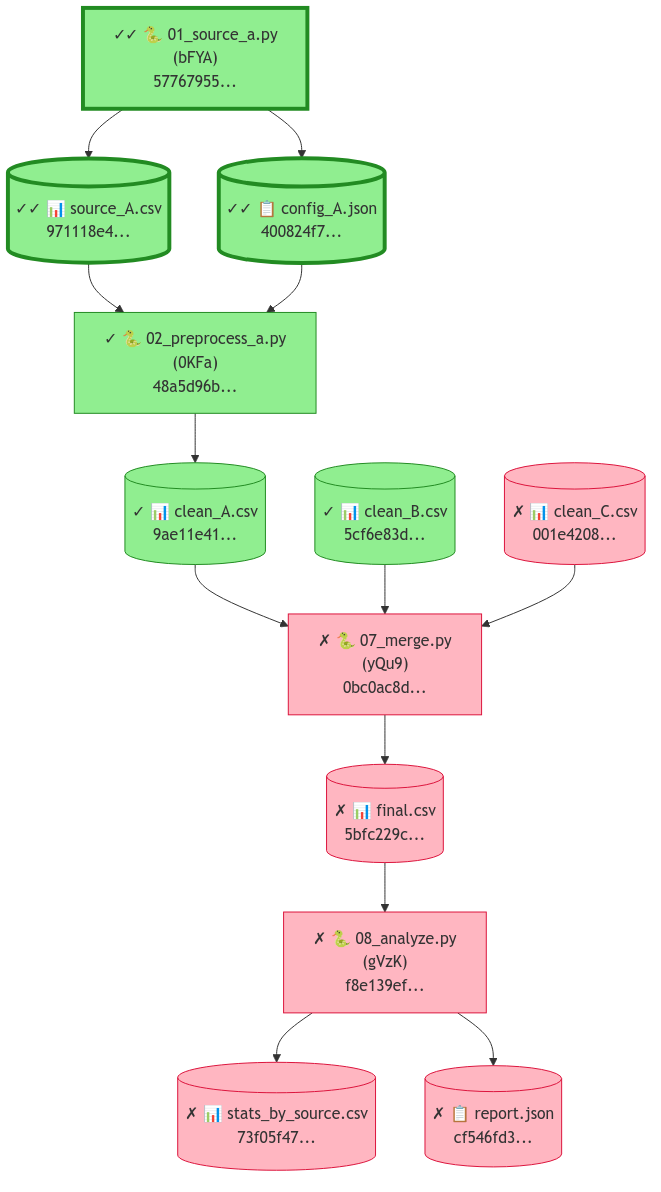
Figure 1. Example DAG visualization. Green nodes indicate verified sessions; red nodes indicate hash mismatches. Clew traces the dependency graph backward from target files to raw data sources.